How a Ripple Tank Works: Wave Properties Explained
Learn how a ripple tank works to demonstrate wave properties like reflection, refraction, and diffraction. Discover physics wave behavior made simple.

A ripple tank is a specialized physics apparatus consisting of a shallow, transparent tray of water, an overhead light source, and an automated wave generator used to visualize, measure, and demonstrate fundamental wave behaviors in two dimensions. Because mechanical water waves move slowly enough to be seen in real time, they act as an excellent, visible proxy for studying more abstract or invisible wave phenomena like light, radio, and sound waves.
Core Structural Components
To understand how a ripple tank operates, it helps to break it down into its five main functional parts:
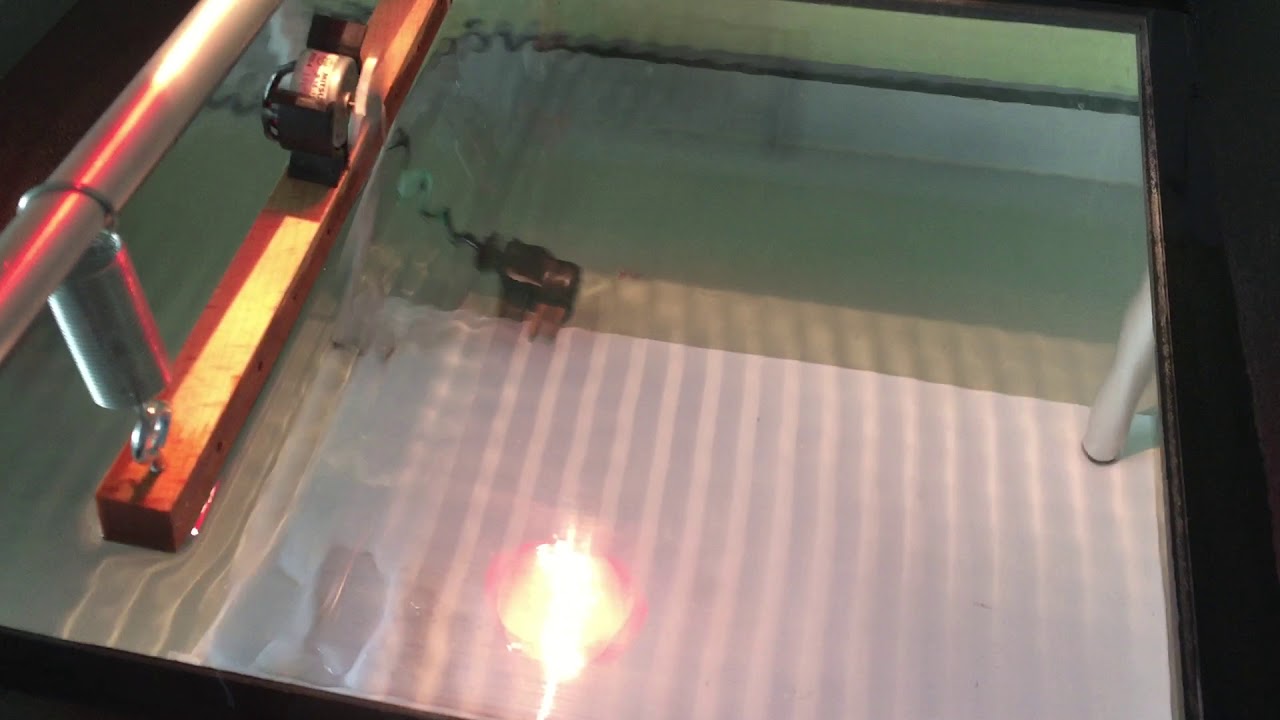
- The Transparent Basin: A shallow glass or plastic tray holds a uniform layer of water, typically filled to a depth of 1 to 2cm. The bottom must be completely transparent to allow light to pass through unobstructed.
- The Wave Generator (Dipper): An electric motor with an offset (eccentric) weight sits on a suspended wooden or metal bar. When the motor spins, it oscillates up and down. Attaching a flat wooden paddle creates straight, linear plane waves; attaching one or two spherical plastic beads produces circular waves.
- The Illumination System: A strong lamp or point-source light is positioned directly above the water basin. It shines straight down through the water column onto a white screen or viewing card placed flat on the table underneath the tank.
- The Stroboscope (Optional): A mechanical spinning disc or an electronic flashing LED light source can be synchronized to flash at the exact same frequency as the wave generator. This makes the rapidly moving ripples appear perfectly frozen or slowed down, allowing for highly accurate measurements.
- Damping Boundaries: The inner edges of the tank are lined with a sloped, textured mesh or foam beach. This absorbs the energy of advancing waves, preventing them from bouncing off the tank walls and muddying the primary wave pattern with unwanted reflections.
How the Wave Patterns Are Visualized
Observing small water ripples directly on a clear surface is difficult because water is transparent and the waves are tiny. The genius of the ripple tank lies in its optical projection mechanism, which takes advantage of light refraction.
When ripples propagate across the basin, the surface of the water deforms into a repeating series of peaks (crests) and valleys (troughs).
- Crests act as convex (converging) lenses: Because the water is thicker in the middle of a crest, parallel light rays traveling downward are bent inward toward each other. This concentrates the light, projecting a sharp, bright line on the viewing screen underneath.
- Troughs act as concave (diverging) lenses: The water is thinner at the bottom of a trough, causing the light rays to spread apart. Because the light is scattered away, a corresponding dark line or shadow is cast onto the screen.
As a result, the scrolling pattern of alternating bright and dark lines on the paper perfectly mirrors the physical troughs and crests of the moving water waves.
Demonstrating the Four Fundamental Wave Behaviors
By placing different obstacles, barriers, or submerged plates into the water path, physicists use the ripple tank to visually demonstrate the foundational laws of wave mechanics:
1. Reflection
When plane wavefronts encounter a solid metal or plastic barrier placed in the basin, they bounce backward. If the barrier is set at an angle, the incoming waves (incident waves) and outgoing waves (reflected waves) can be tracked. By measuring the paths relative to a line perpendicular to the barrier (the normal), the tank clearly proves the Law of Reflection: the angle of incidence exactly equals the angle of reflection
2. Refraction
Refraction is the bending of a wave when it changes speed as it enters a different medium. In water, wave speed is strictly governed by depth—waves travel significantly slower in shallow water and faster in deep water.
To demonstrate this, a thick glass or plastic block is submerged in a section of the tank to create an ultra-shallow zone. As plane waves cross the boundary from deep water to the shallow zone, they abruptly slow down. This causes the wavefronts to bunch up closer together (the wavelength decreases) and twist toward the normal line, dynamically illustrating how light bends when entering glass or water.
3. Diffraction
Diffraction describes how waves bend, spread out, and curve around obstacles or when passing through narrow gaps. By placing two barriers in the ripple tank with a small opening between them, users can observe this phenomenon directly.
- If the gap is much wider than the wavelength, the waves pass straight through with almost no distortion, curving slightly only at the absolute edges.
- If the gap is narrowed until it is equal to or smaller than the wavelength, the passing waves completely change shape, bending into wide, semi-circular wavefronts that radiate outward into the shadow zones behind the barrier.
4. Interference (Superposition)
When two distinct wave sources operate at the exact same frequency, they are considered coherent. By attaching two spherical dippers to the oscillating bar, two sets of circular waves expand simultaneously and crash into one another.
Where two crests or two troughs overlap, they reinforce each other via constructive interference, creating areas of maximum wave height that project highly contrasting, intense bright and dark lines. Where a crest meets a trough, they cancel each other out via destructive interference, leaving flat, undisturbed lines of water that appear as calm, blurred gray paths on the viewing screen.
1. Conceptual Question: Optical Projection
Question: In a ripple tank projection, why does a wave crest appear as a bright line on the screen underneath, while a wave trough appears as a dark line?
Answer:
- The Crest: A wave crest curves outward, acting exactly like a convex or converging lens. When parallel light rays from the overhead lamp pass through it, they are bent inward and concentrated together, forming a bright band on the screen.
- The Trough: A wave trough curves inward, acting like a concave or diverging lens. When light rays pass through it, they are bent outward and scattered away, leaving a dark shadow band on the screen.
2. Conceptual Question: Refraction Mechanics
Question: A student places a glass plate into the ripple tank to make one section shallower. When the waves cross from the deep water into the shallow water, what happens to the wave's speed, wavelength, and frequency?
Answer:
- Speed: Decreases. Water waves travel slower in shallow water due to increased friction and interactions with the boundary floor.
- Wavelength: Decreases. Because the front of the wave slows down while the back of the wave is still moving fast in deep water, the wavefronts bunch up closer together.
- Frequency: Remains constant. The frequency is entirely determined by the source (the mechanical motor/dipper), which does not change pace just because the wave enters a new depth.
3. Calculative Question: Using the Wave Equation
Question: A wave generator in a ripple tank vibrates at a constant frequency of 20 Hz. A student uses a ruler on the projection screen and measures that the total distance across 5 consecutive bright lines (wavelength spaces) is 6.5 cm. Calculate the speed of the waves in meters per second (m/s).
4. Conceptual Question: Analyzing Diffraction Barriers
Question: Plane waves with a wavelength of 1.5 cm approach a barrier gap that is 10 cm wide. They pass through with very little bending. How can a student modify the setup to make the waves diffract (spread out) into wide, circular semi-circles? Provide two distinct methods.
Answer:
To achieve maximum diffraction, the gap size must be close to or smaller than the wavelength of the waves. A student can do this by:
- Method 1 (Change the gap): Physically push the two barrier walls closer together until the gap width is narrowed down to 1.5 cm or less.
- Method 2 (Change the wave): Decrease the frequency of the motor or add deep water to increase the wavelength until the wavelength grows large enough to match the 10 cm opening.
5. Conceptual Question: Wave Interference Lines
Question: When using two spherical dippers to create an interference pattern, a student notices faint, blurry, gray lines radiating outward where the water looks completely still. What type of interference is occurring here, and what is happening to the crests and troughs at these locations?
Answer:
- Interference Type: This is destructive interference.
- Mechanism: These blurry paths are called nodal lines. At these exact coordinates, a wave crest radiating from the first dipper meets a wave trough radiating from the second dipper. Because the crest (positive displacement) and trough (negative displacement) are of equal size, they completely cancel each other out, leaving the water flat and undisturbed.
Share
What's Your Reaction?
 Like
0
Like
0
 Dislike
0
Dislike
0
 Love
0
Love
0
 Funny
0
Funny
0
 Angry
0
Angry
0
 Sad
0
Sad
0
 Wow
0
Wow
0